
Fictional Narratives As Intelligence Simulations
Social engineers are two steps ahead of the public
Control of the narrative is the single greatest power in rulers’ armory
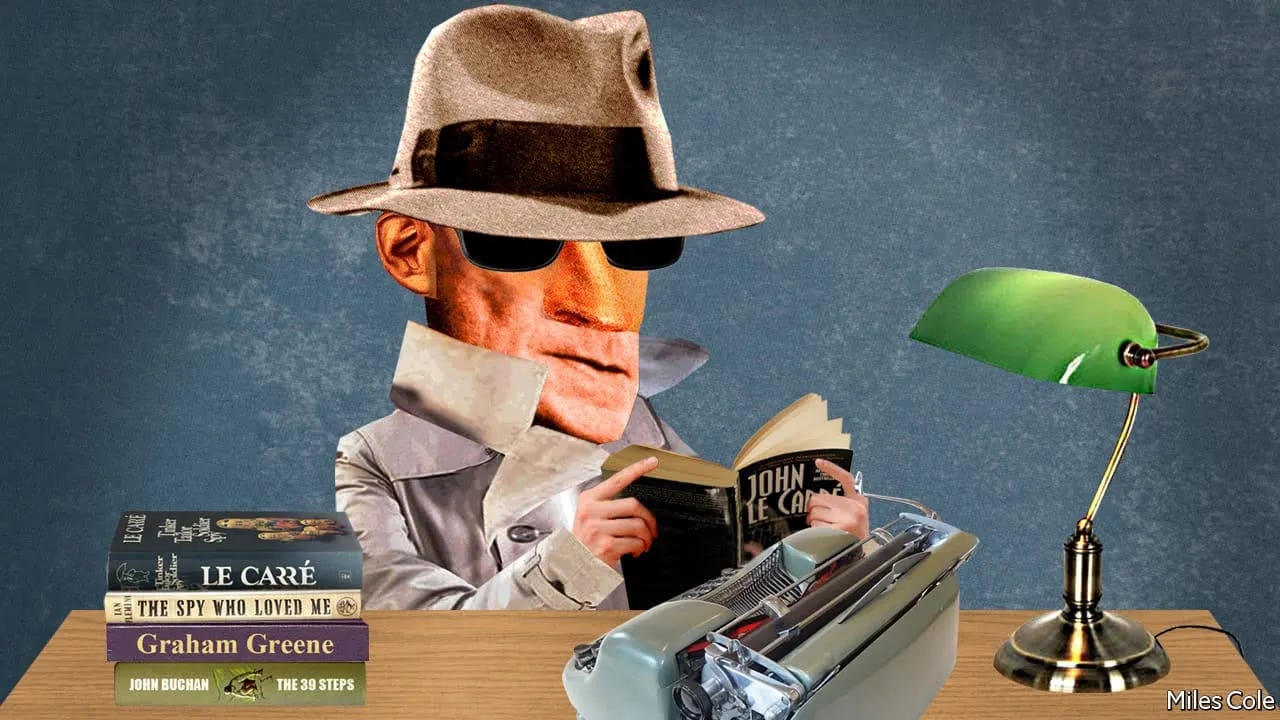
H. G. Wells, Orwell, Le Carré, Greene, Dahl, Fleming & E Howard Hunt
Will AI and Palantir shape the military and social war scapes of tomorrow?
Words as the oldest technology, recall ideas more directly than images
Military authors project into the future, landscapes of conflict and control
These are only my thoughts and readings. What do you think?
Related:
Drone Psyop Continues For Your Own Good - ‘Take me to your leader’ (Dec 16, 2024)
9/11, Part One: They Wouldn’t Do That - The World Trade Center bombing set the narrative (Sep 10, 2024)
Malaria Scarier Than The Other Bug - Or how finance capital and colonial history entwine with Shakespeare’s swallows (Jul 05, 2023)
Spies, Dupes and Charities (Aug 7, 2021)
How -Isms Make War - The Anglosphere seems to want conflict; we must deny them (Nov 10, 2023)
Economic Gurus Wrestle With Truth - Elites at WEF & Davos ask why nobody trusts them (Jan 19, 2026)
See also:
The Arc Of Yuval Noah Harari and his covenant with Klaus Schwab of the World Economic Forum (Apr 28, 2022)
Jeffrey Epstein’s Drama of the Superior Gene - The money grab under cover of Covid (Jul 22, 2025)
German Film That Foresaw The Plandemic - Peter Fleischmann captured medical tyranny in a Seventies blend of thriller and satire (Mar 23, 2022)
Mindful Psyops For The New Age - Globalism as a front for corporate might (Mar 16, 2025)
Fabians, Milner Group And War - Britain commits to Ukraine, cuts pensions, announces austerity (Jul 29, 2024
(2,900 words or just over 12 minutes of our company)
Jan 20, 2026
It is not artificial intelligence that is reshaping the world but fictional intelligence.
This is a novelistic form of war gaming, seeking options to surprise a rival country. It may be political interference to discredit an opponent. Futurists look ahead to new military technologies or measure how societies evolve in war.
We are not talking about cultural programming: the role of Hollywood in seeding the population with the appropriate response to life-changing events. Tom Secker at Spy Culture documents the involvement of the Pentagon, Navy, Air Force and CIA in shaping movies for popular consumption. [1]
Holly woo
After Nine-Eleven the airwaves were blasted with propaganda through TV series like Homeland and 24. Jack Bauer would hunt down a terrorist or group (almost always Arabs) injecting biological weapons into the public consciousness as an ever-present, invisible threat.
Arnon Milchan managed to combine weapons smuggling with the finance of 130 films. Chris Carter of The X-Files and The Lone Gunmen is the spy watcher’s favourite television producer.
Our concern in this article is how bureaucracies, military and intelligence explore vectors, threats, opportunities, work through the use of fiction.
Fictional intelligence can influence policy in dangerous ways but it can also raise moral hurdles; it presents us with the consequences of our actions. Human thinking is shaped by the need to defend our conclusions. The stakes are real.
That is different to artificial intelligence.
We already have examples of AI making stuff up, which software engineers call hallucinations. Customers like software that provides helpful results, while accuracy costs time and money. AI’s dirty secret is captured in the phrase, “how much accuracy is good enough.”
Palantir Technologies has developed the Mosaic platform for battlefield surveillance. It draws on 400 million data points including satellite imagery, trade flows, personnel networks and social media footprints etc.
Hallucination seems to be a problem of large language models (LLM) while Palantir’s Foundry and Mosaic platforms do data management. However Palantir’s Artificial Intelligence Platform (AIP) uses LLMs to query Foundry’s data.
Writers still seem to have jobs and it is not just because of flaws in the machine.
Strict machine
A machine does not need to act upon, nor stand behind, its conclusion. That changes the nature of thinking.
“Instead of working through uncertainty, we receive finished responses... It misses context, invents details, and can sound confident about things it does not actually understand,” John Nosta writes in Psychology Today. [2]
Novelists and TV dramatists are the imagineers who create possible narratives for the establishment’s operations. Such operations tend to be repetitious and formulaic, so they benefit from a fresh spin.
Old school
Fictional intelligence is not new. And it was never purely military.
It was the Fabian and associate of the Milner Group H. G. Wells who invented the genre. He foresaw the risks of modernity but was closely linked, perhaps in the employ, of those who would engineer change.
See Fabians, Milner Group And War - Britain commits to Ukraine, cuts pensions, announces austerity (Jul 29, 2024)
Sociologist Ulrich Beck (1944-2015) thought it was not engineered change but uncontrolled uncertainty that shaped society. From this perspective Wells’ work was speculative.
Yet Wells shaped popular perceptions. In today’s lingo he “black pilled” his readers, creating the ideological prison-house or Panopticon.
War of the Worlds
It is not that a trap has been sprung but, by focusing on future threats, our enjoyment of the present is changed.
Beck emphasizes that risks are “particularly open to social definition and construction.” They can be “changed, magnified, dramatized or minimized within knowledge” (World Risk Society, 1998).
David Shackleton notes that Wells’ utopias participate in such a construction, drawing on his interests in biology, ecology and an obsession with species extinction. He saw a socialist world state was the way to control the species and its use of resources. [3]
Wells’ answers were based in what today is called World-Systems analysis, developed by Immanuel Wallerstein.
In turn, Wallerstein’s ideas were close to those of the Ford Foundation, which funded his work, and which in the1950s declared its objective “so to alter our life in the United States that it can be comfortably merged with the Soviet Union.”
See Spies, Dupes and Charities (Aug 7, 2021)
See How -Isms Make War - The Anglosphere seems to want conflict; we must deny them (Nov 10, 2023)
If you doubt the continuity of ideas, Wells was taught by “Darwin’s Bulldog” T. H. Huxley at the Normal School of Science (now part of Imperial College London) and George Orwell was Taught by Aldous Huxley at Eton, and T. H. Huxley’s other grandson Julian Huxley co-founded UNESCO.
The Huxleys influenced the Acclimatization Societies which aimed to spread species and plants across the empire, while purging the organic world through the “systematic extermination of tiresome and mischievous species.”
Acclimatizers were interested in how plants, animals, the science of breeding, and the social engineering of humans could be practised and studied — and they depended on the trade networks and sea lanes of the European imperial project. Today’s globalists are their direct descendants.
See Malaria Scarier Than The Other Bug - Or how finance capital and colonial history entwine with Shakespeare’s swallows (Jul 05, 2023)
Consider the following titles of H. G. Wells:
The Island of Dr. Moreau (1896) introduces a chimera of man and beast.
Martians in The War of the Worlds (1898) unleash what Wells called a Heat-Ray, a super weapon capable of incinerating helpless humans with a noiseless flash of light.
In When the Sleeper Wakes (1899), the protagonist after 200 years finds a dystopian London in which people have audio books, air travel television yet are oppressed and denied justice.
A Modern Utopia (1905) foresees a one world government.
In Men Like Gods (1923) people communicate exclusively through wireless systems that employ a combination of voicemail and email.
Things To Come (1936) has a pandemic, polycrisis, a great reset and space travel.
Spy vs spy
So much for the social engineers of the Fabian and Milner groups. The intelligence agencies have their own stable of authors.
