
3 Crises - Volatility increasing: Nukes, Oil, Caribbean Instability
Managed or chaos, what order emerges?
Nuclear treaties suspended as New START expires
U.S. says it downed an Iranian drone near USS Abraham Lincoln
Iran seizes two foreign oil tankers in Persian Gulf for ‘smuggling’
European Union has swapped dependence on Russian energy for U.S. gas
U.S. military heads to Haiti as presidential transition fails to deliver
Related:
Weapons Stocks Jump On War Bonanza - Oligarchs going after Venezuela also stripping West’s middle class (Jan 05, 2026)
Sun Sets On Nuclear Treaty & Haiti’s Transition - Powerful & the dispossessed are in the same pot (Jan 22, 2026)
EU & Mercosur, Betrayal Or Deal? - Cheap imports slap in face for besieged farmers (Jan 11, 2026)
U.S. Forces Seize Venezuela’s Maduro - Deal or suprise attack it opens door to civil war (Jan 03, 2026)
Trump’s Stars Align With Age Old Interests - Cabinet picks do little to quiet the drums of war (Nov 15, 2024)
Readying The Digital Chains - Programmable money by another name (Apr 15, 2025)
Art Of The Deal In War & Peace - Will Trump overcome the globalists? (Nov 03, 2024)
Europe, Gas And The Endgame - Switching the energy axis from East-West, to South-North (Sep 30, 2022)
(2,200 words or 10 minutes of your company)
Feb 5, 2026
Crisis One - START Expires
The last remaining nuclear arms control treaty has expired without a replacement. Russian president Vladimir Putin had proposed a one-year extension of the warhead limits.
Russia says it views “negatively” the failure of the United States to respond to its offer of a one-year extension, but is committed to nuclear stability.
Most Americans want president Donald Trump to accept the Russian offer to extend New START.
A You Gov poll found that 87 per cent of voters want the U.S. to take a deal that would limit both countries’ nuclear weapons for at least another year. Almost three-quarters of voters said removing all limits on nuclear weapons makes the U.S. less secure.
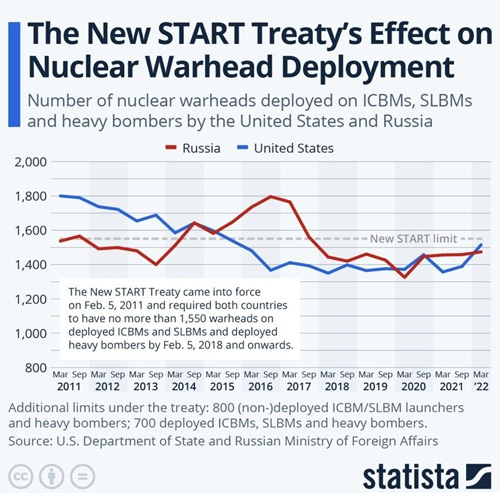
New START limited the number of nuclear warheads deployed to 1,550. This included those mounted on missiles, submarines and heavy bombers. It limited delivery vehicles, and the number of launchers, whether deployed or not, to 800.
Russia, as heir to the Soviet Union, has been involved in nuclear arms control treaties with the U.S. since 1969. Agreements have lapsed before but each time there had been a new deal on the table.
This time there are no negotiations and none are planned.
China syndrome
New START was signed in haste in 2010, after the previous Strategic Arms Reduction Treaty expired.
Trump told The New York Times last month he was ready to let the treaty expire and wasn’t concerned about potential consequences. “If it expires, it expires. We’ll do a better agreement.”
Any new deal should take China into account: it is estimated to have about 600 warheads. However Beijing said it would not join nuclear talks “at this stage.” A foreign ministry spokesman said it was committed to “maintaining global strategic stability.”
The U.S. is estimated to have between roughly 3,500 and 5,250 total warheads, and Russia around 5,500.
Crisis Two - Energy Flux
The European Commission which runs the European Union fears it has become too dependent on U.S. liquefied natural gas (LNG) which is supposed to replace Russian gas that flowed through the Nord Stream pipeline before its detonation in September 2022.
The blast was hailed as a moment of liberation. Europe would punish the Russians and diversify into U.S. LNG.
However, as Irina Slav writes for Oil Price, it was not the liberation day that Brussels hoped for. It is increasingly dependent on more costly gas delivered by sea. [1]
European leaders clashed with the Trump administration over Greenland - and suddenly realised that Washington has increased bargaining sway.
Energy Commissioner Dan Jorgensen told reporters that the EC was looking for other LNG suppliers. However the EC’s own strict rules on methane leaks throughout the LNG supply chain means few suppliers meet its green standards.
There is no supplier able to match the U.S.. Last year EC president Ursula von der Leyen signed with president Trump to increase U.S. energy imports to $250 billion.
Breaking Russia
Azerbaijan has formally broken ground on two 330 kilovolt (kV) transmission lines each of which will supply up to 1,000 Megawatts of electricity to Europe.
The TRIPP corridor, or Trump Route for International Peace and Prosperity aims to to connect Armenia and Azerbaijan to the European Union, both economically and politically.
This is in addition to the Middle Corridor already operates through Georgia and Azerbaijan, [2]
Under a deal struck in January a US-Armenian joint venture company will carry out the work, though it has not yet been established.
AzerEnergy will build another transmission line from Nakhchivan to Turkey. There is also a project for a Black Sea transmission line through the Georgia, Romania, and Hungary.
Washington is behind these moves and its objective is to break Europe’s reliance on Russian gas by putting in place competitive infrastructure.
See Europe, Gas And The Endgame - Switching the energy axis from East-West, to South-North (Sep 30, 2022)
Hormuz buzz
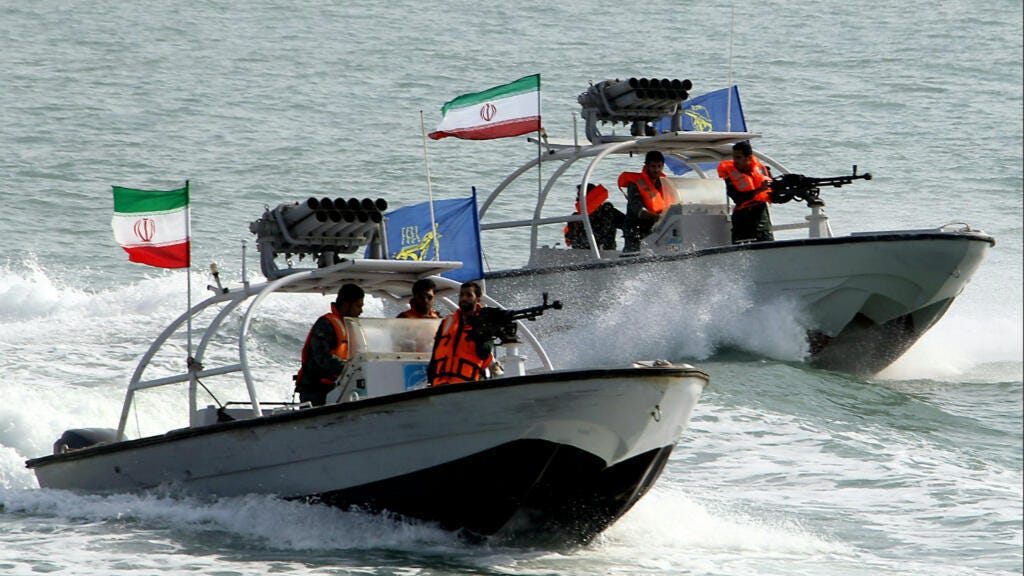
And then there’s Iran, which on Thursday detained two tankers near Farsi Island in the Persian Gulf for “smuggling fuel.” The day before, the U.S. says it shot down an Iranian drone that approached “with unclear intent” the USS Abraham Lincoln aircraft carrier in the Arabian Sea.
Western analysts are confident the U.S. and its allies can survive without Iranian oil and gas. This sounds rather like the “call Putin’s bluff” braggadocio. They know that closing the Gulf of Hormuz, which transits about 20 per cent of global oil consumption and 25 per cent of LNG, could be dangerous for the West caught in a tightening energy crunch.
The U.S. may be energy rich, but it faces a capacity challenge given the demands of artificial intelligence data centres. These consume four per cent of energy now but that’s expected to rise to 12 per cent within two years.
Data centres are projected to need 44 GW of additional capacity by 2028, while constraints on the grid allow mean about 25 GW is projected -- a gap of 40 per cent, according to Morgan Stanley.
Energy crunch
This is one reason the military-banking complex, which drives Western foreign policy, is keen to assert control over Iran’s energy. Another is the challenges facing the U.S. dollar which could use mineral and energy resources to collateralise the monetary system.
See Trump’s Stars Align With Age Old Interests - Cabinet picks do little to quiet the drums of war (Nov 15, 2024)
Oil Shock
Oil traders are locking in contracts because of the price volatility that is likely ahead. No-one knows where oil prices could go but some suggest from $65–$70 a barrel at present to between $120 and $150 a barrel.
If prolonged it could cause an oil shock like the 1970s. Next, you have to reassess history.
The ‘70’s oil shock was not the as we are told the Arabs holding the West hostage. It was the U.S. that needed high oil prices to maximise the revenues that the Saudis agreed to reinvest in U.S. Treasuries, allowing Washington to increase its spending while making the petrodollar more mighty still.
See Weapons Stocks Jump On War Bonanza - Oligarchs going after Venezuela also stripping West’s middle class (Jan 05, 2026)
Monetary reset
This time around an oil shock would likewise recalibrate the financial system as opposed to the productive element. Yes, it would be inflationary but contrarian thinking must take into account the self interest of a creaking monetary system and the “real economy.”
It would further change the balance of power between banks and industry, lender and creator — but we saw that in the 2008 crash when governments sacrificed the economy to save the banks.
Not to re-open the discussion, the investment banks and even large commercial banks to not finance industry: the largest corporations issue bonds and raise their own finance. As the economist Richard Werner has pointed out, it is local banks that finance business.
The centralisation of banks in the European Union partly accounts for the EU’s poor performance compared to the U.S. Another oil shock would take the U.S. down the European path.
That may be, from the perspective of the Federal Reserve and the Bank for International Settlements (the central bankers’ central bank), just what the doctor ordered.
Donroe Doctrine
Venezuela has nearly tripled its oil exports to the U.S. after the removal of president Nicolas Maduro. This was more than the market could absorb, causing prices to fall - though U.S. refineries in the Gulf said prices wree still to high.
It seems the fears of civil war, cited here, were misplaced. Venezuela has opted for transactional politics, for now.
See U.S. Forces Seize Venezuela’s Maduro - Deal or suprise attack it opens door to civil war (Jan 03, 2026)
After Trump put pressure on India not to buy Russian oil there was hope that Delhi might absorb the Venezuelan crude -- but not so far. India’s Reliance industries has said it is considering Venezuelan oil.
China had been Venezuela’s main customer but after the seizure of Maduro Washington said it would control its oil sales, and has cut China out. It also stopped sales to Cuba, and Mexico has since become a critical oil supplier.
Last week Mexican president Claudia Sheinbaum said a temporary suspension of supplies to Cuba was technical and not due to Washington’s pressure.
Crisis Three - Haiti’s Transition
The U.S., ever caring for Haitian welfare, has sent a warship to the capital Port Au Prince before the temporary government’s remit expires in two days. A U.S. military cargo jet landed at the main airport yesterday.
“Their presence reflects the United States’ unwavering commitment to Haiti’s security, stability and brighter future,” stated U.S. Southern Command.
The country has not yet selected a replacement for the Presidential Council of the Transition (CPT). Last week it voted to oust prime minister Alix Didier Fils-Aimé.
By sending military, the U.S. is indicating its support for Fils-Aime, even though he has failed to put in place the promised elections to replace president Jovenel Moïse, who was assassinated in 2021.
The people contend with food shortages, inflation and gangs which some argue are not so much criminal as political enforcers.
Some members of the CPT are suspected of pursuing their own presidential chances, even of sponsoring gangs.
Local organisations have said the council will be illegitimate if it tries to extend its remit. [3]
See Sun Sets On Nuclear Treaty & Haiti’s Transition - Powerful & the dispossessed are in the same pot (Jan 22, 2026)
Bonus Crisis
Where is the BRICS alliance, which had promised a rival economic order, one that would offer the Global South a path to development outside of the handcuffs of the post-WWII Bretton Woods, rules based international order also known as the Washington Consensus.
These countries were forced, by sanction and exclusion, in some cases, from the Western banking system, to seek an alternative to the U.S. dollar.
See BRICS Answer To War On Resources - Replacing conflict as the means to support the dominant currency (Oct 13, 2024)
However, it has become clear in the past year that Washington is managing a weakening of the dollar, and the BRICS shift to national currencies backed by commodities, from oil to gold, are not inconsistent with this aim.
The dollar is, in turn, being depreciated against other currencies, similar to the Plaza Accord of 1985 which reduced the U.S. deficit by a coordinated rise in the German mark and Japanese yen.
In the financial markets they are calling this Plaza II or the “Mar-a-Lago Accord.” This time around it is not Japan but China which must agree to voluntarily strengthen its currency.
Perhaps, after all, the next shift in the monetary system is being co-ordinated behind the scenes by the Bank for International Settlements.
See Readying The Digital Chains - Programmable money by another name (Apr 15, 2025)
Europe dished
The European Union, which is run by the NATO-adjacent, unelected European Commission, has struck an alliance with Mercosur, and another with India.
See EU & Mercosur, Betrayal Or Deal? - Cheap imports slap in face for besieged farmers (Jan 11, 2026)
The South American trade deal places European farmers at a disadvantage. The Indian trade and immigration deal focuses on on manufacturing and the services sector, including “agreement on mobility”.
Both deals proceeded at glacial pace for about 20 years, and then were accelerated in the past six months.
Why the sudden acceleration?
After the EC capitulated to Washington and struck yet another trade deal not to its advantage.
BRICS House
Add them together and it seems the EC is being driven by Washington’s sheep dogs to built alternative trade networks to challenge BRICS.
The establishment narrative is that it is a response to the Trump administration’s tariffs; the EU pursuit of strategic autonomy; cutting reliance on China.
But at what cost: the EU abandoned its demands that South America stop deforestation and observe climate goals; EU abandoned concerns over human rights and labour standards in India.
This sequence of events shows that if you keep your eye on the ball - and follow writers who, likewise, are scanning events for strikes and misses - we can take an accurate guess at the outcome before the mainstream media comes to its senses, if it ever does.
Here at Moneycircus we don’t rewrite or delete our assessments, even if they turn out to be wrong. That would be a travesty, for they are our guide to how things were seen at the time. That is how we gain historical perspective.
See Art Of The Deal In War & Peace - Will Trump overcome the globalists? (Nov 03, 2024)
We don’t make predictions. That is not the job of a journalist. Anyhow, if you get them right, you should give equal prominence to your mistakes. From what do we learn?
[1] Irina Slav, Jan 31, 2026, Oil Price - EU Faces Hard Choices after LNG “Wake-Up Call”
[2] ISPI, Dec 2025 - The EU’s Role in the TRIPP
[3] Echo Journal, Feb 5, 2026 - Washington réitère son appui au Premier ministre defacto, Alix Didier Fils-Aimé
If I was as stupid as all these experts and government managers - without their financial fraud banker backup - , I would be broke, homeless, and on drugs. Is that the plan?
In fact the Western expertise in survival is woefully inadequate compared to the 3rd world. Smoke and mirrors and Financial Hit Men don't cut it any more. Hard resources.
Knives. Expect knives.
It really is laughable that people can say these kinds of with a straight face, they must be in stitches behind closed doors….